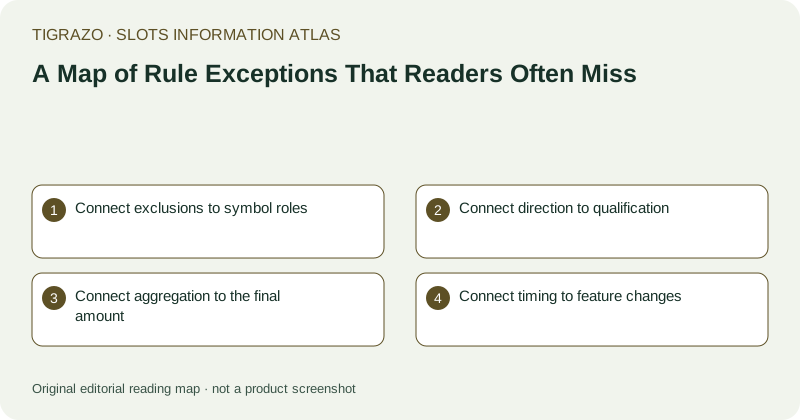
Connect exclusions to symbol roles
A broad statement such as wild substitutes for symbols may have exclusions for scatters, jackpots or special feature symbols. Attach each exclusion directly to the substitution branch. Otherwise a general summary can look accurate while producing a wrong result in the one case that matters. The same applies to symbols restricted to certain reels or modes. A symbol's presence on screen does not establish that its effect is active everywhere. Read qualifying phrases such as except, only and during as operational instructions, not optional detail.
Connect direction to qualification
Three matching symbols can satisfy a count while failing a direction rule. A hypothetical line game might require matches to begin at the leftmost reel. Symbols on reels two, three and four would then not qualify merely because they are consecutive. Other games may use different directions. On the map, count and direction should both connect to the qualifying-pattern node. This prevents a common shortcut in which the reader checks the number of symbols but ignores where the qualifying sequence must start or which positions are eligible.
Connect aggregation to the final amount
A longer match may replace its shorter embedded matches rather than paying all lengths together. Separate line awards might combine, while particular feature awards use another convention. Add a highest-only or cumulative label where the rules establish it. In a hypothetical example, a five-symbol line award of 10.00 should not automatically receive an extra 2.00 for its first three symbols. The paytable can display both values without making them independently payable on the same line. The aggregation rule decides how the visible possibilities become a settled total.
Connect timing to feature changes
Before, after, next and remaining can change the arithmetic of a feature. A multiplier increase after an award may apply only to a later evaluation. A sticky symbol may expire before the next refill rather than after it. Draw timing labels on the connections between states. Do not let the visual drama of an animation override the written sequence. Also identify whether a change persists through a bonus or resets after a non-winning round. These are different models even when their opening screens look nearly identical.
Connect limits to stopping behaviour
A cap can limit a component, a combined round or an entire feature, and reaching it may stop further actions. Jackpot eligibility may also depend on specific conditions rather than the ordinary stake alone. Add those limits to the relevant node instead of listing every maximum in one disconnected box. Finish by scanning the rules for exception words and checking that each has a place. This map improves completeness, not prediction: knowing every exception still does not make a future award due or turn a maximum into a likely session outcome.