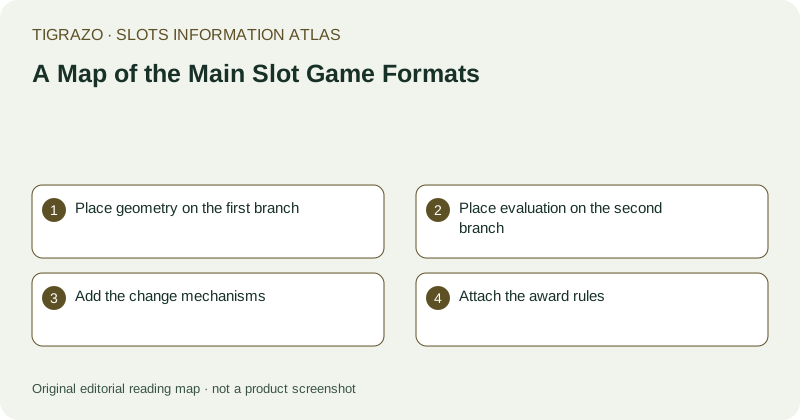
Place geometry on the first branch
The first branch describes the visible arrangement: reel count, position count and whether those positions change. A compact three-reel display and a large grid occupy different places on this branch, but neither tells you how awards are evaluated. Record active positions separately from visible ones where the rules make that distinction. Geometry is the map's physical outline. It helps locate symbols and follow examples, but it cannot establish minimum matches, directions, payout units or the role of a special symbol without additional information.
Place evaluation on the second branch
Paylines connect defined positions across reels. Ways formats evaluate eligible matching combinations under their specified adjacency and direction conditions. Cluster formats evaluate connected groups under their own contact rules. These mechanisms should be separate nodes rather than points on a simple scale from old to new. A five-by-three layout might support either lines or ways. A large grid might contain exceptions that complicate a basic cluster description. The map's purpose is to identify the governing question, not assume all examples within a category behave identically.
Add the change mechanisms
Reel expansion, symbol removal, refill and transformation describe changes to a state or sequence. They are not necessarily standalone evaluation formats. Connect each change to the point where it occurs: before evaluation, after an award or during a feature. A cluster game can remove winning symbols and refill, but removal can also accompany other mechanisms. Mapping these as an overlay avoids the mistake of assuming every cascading display uses clusters or that every expanding layout counts ways. Read the documented sequence for the actual relationship.
Attach the award rules
Every format node needs links to minimum qualification, symbol exceptions and payout basis. For a hypothetical line example, three matching symbols starting on reel one may qualify. For a hypothetical cluster example, five edge-connected symbols may qualify. Neither illustration supplies a currency amount until a paytable and stake basis are added. Keep scatters and special triggers on their own branches when they operate outside the ordinary evaluation mechanism. One spin may therefore connect to several rule nodes without all of them using the same geometry.
Use the map as a reading route
Read a candidate in this order: layout, evaluation, changes, exceptions and valuation. Mark missing connections rather than filling them with assumptions about familiar formats. The final map should allow you to explain why a symbol pattern qualifies and which information determines its amount. It should not rank formats by generosity or imply that a particular geometry predicts results. RTP, hit frequency and volatility belong on another layer. They describe mathematical characteristics, not conclusions that can be read from reel count, grid size or visual complexity alone.