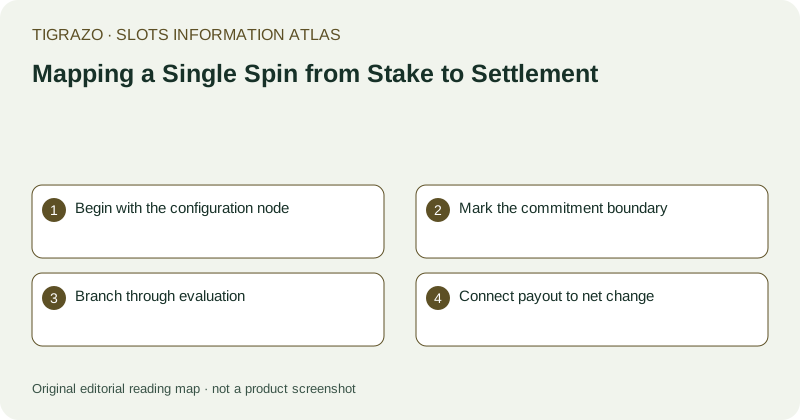
Begin with the configuration node
Before commitment, identify the selected total stake, active mode and any optional cost. A control may display components such as line stake or coin value alongside the total. The map should link those components to the final committed amount rather than treating them as separate charges automatically. Also distinguish adjustment controls from paid-action controls. At this stage, the important question is what the next confirmed action will commit under the displayed settings. A previous stake selection does not establish the current one after a mode change.
Mark the commitment boundary
The next node is the point where the paid round is initiated. Its exact interface behaviour is game-specific, so use the documented action rather than guessing from button placement. Once the stake is committed, the display may animate while the round is processed. Animation speed is not itself the settlement rule. Keep the act of initiating a round separate from its visual presentation and from later balance updates. This distinction prevents a delayed display from being interpreted immediately as either a new charge or a missing award.
Branch through evaluation
The evaluation node applies the game's documented mechanism: line routes, eligible ways, clusters or another rule. From there, draw separate branches for ordinary awards, scatter awards and feature triggers where relevant. A hypothetical spin might pay a line award and start a bonus, but that combination requires explicit rules. If a cascade produces another evaluation, represent it as a sub-sequence within the defined round. Do not automatically count each animation as a new paid spin or assume every visible event creates a separately payable award.
Connect payout to net change
In a hypothetical example, an ordinary round commits 0.50 currency units and settles with a payout of 1.20. Its net balance change is plus 0.70, assuming no other transaction belongs to that round. A payout of 0.20 would instead mean a net change of minus 0.30. Put payout and net change in different boxes. This keeps a positive award from being labelled a net gain merely because it appears with celebratory graphics. Any feature total must follow the rules defining which awards belong in the settlement.
End at the recorded result
The final node is the settled round record, where available, rather than the last visible animation. If the display is interrupted or a result seems inconsistent, preserve the round identifier, time, stake and recorded outcome for support. Avoid repeated paid actions or redeposits as a way to test whether a round settled. The map's practical value is locating the uncertainty: configuration, commitment, evaluation, presentation or record. It does not predict the next outcome, and a previous unsettled-looking screen does not make a future award due.