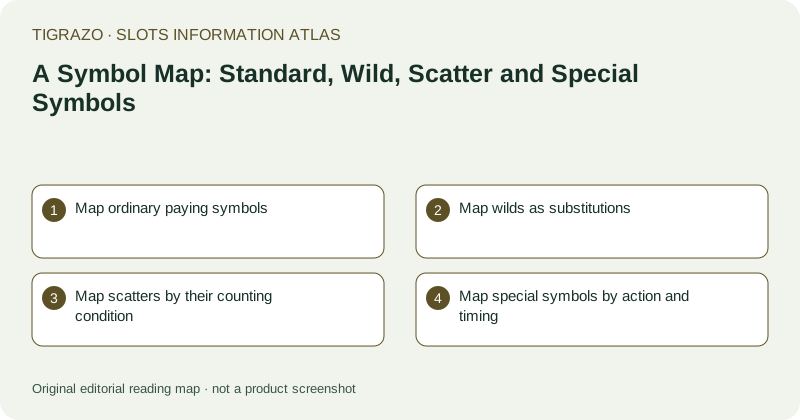
Map ordinary paying symbols
Standard symbols connect to the main award mechanism and their paytable entries. Their meaning depends on the required count, position and direction. A high-looking design does not establish that it pays more than another symbol. Read the actual table. Some symbol groups share payout values; others have separate rows. Put those values on the map only with their units and qualifying lengths. A symbol name alone is not enough to calculate an award or to determine whether a visible collection satisfies the evaluation rules.
Map wilds as substitutions
A wild connects one symbol to another through a substitution rule. Label that connection with its limits: which symbols it can represent, where it can appear and whether it carries a multiplier. Wilds often have exclusions, especially for scatters or special symbols, but the actual rule must be checked rather than assumed. A wild may also have its own payout or persistent behaviour. Those are additional branches, not automatic consequences of substitution. Separate what the symbol replaces from any other effect associated with its presence.
Map scatters by their counting condition
Scatter rules commonly evaluate qualifying symbols outside ordinary line routes, but eligible positions and counts remain game-specific. A scatter may pay, trigger a feature, do both or serve another documented purpose. Draw separate connections for payout and trigger conditions if they differ. Three scatters might start a feature while a different count determines an award, for example, but that statement must remain hypothetical unless the rules establish it. A symbol's label should never be used to supply a missing trigger count or assumed payout.
Map special symbols by action and timing
Collectors, expanders, transformers and other special symbols need action verbs on the map. What do they collect, expand or transform, and when? Identify the source, target, timing and persistence of the effect. A hypothetical collector might gather displayed values only during a bonus; that does not imply the same behaviour in the base game. If a symbol has multiple roles, give each its own connection. This is clearer than placing it in one catch-all special box that hides the conditions needed to understand a result.
Use a symbol audit route
For any unfamiliar symbol, ask five questions: where can it appear, what qualifies its effect, which objects does it affect, when is it evaluated and what resets afterward? Then locate the relevant paytable or feature rule. Keep unexplained artwork outside the operational map until its role is established. The completed map should help interpret a hypothetical result without guessing from colour or size. It does not reveal future symbol probabilities, and frequent recent appearances do not prove that the same symbol is more or less likely on an independent next spin.