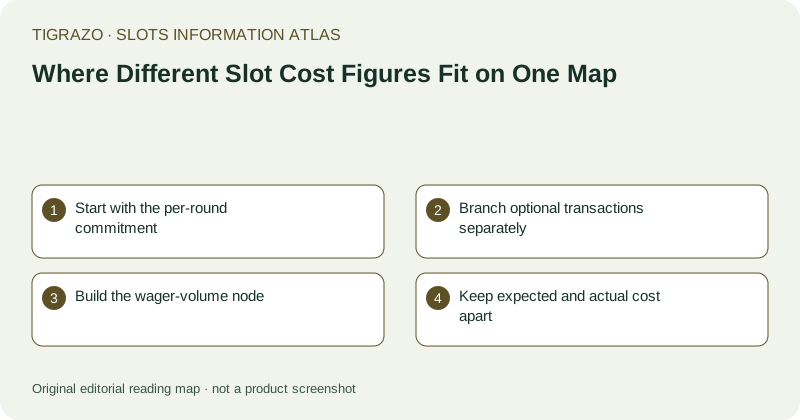
Start with the per-round commitment
Total stake is the amount committed to an ordinary round under the selected configuration. Line stake, coin value and similar components may help determine it, but their relationship must come from the rules. In a hypothetical arrangement with ten equally staked lines at 0.03 currency units each, total stake is 0.30. Do not add the line total to the already displayed total stake; those are two representations of the same commitment. The map should show components flowing into the total, not accumulating beside it as extra charges.
Branch optional transactions separately
A feature purchase or paid mode may have a price expressed as a stake multiple or a final currency amount. In a hypothetical example, an option costing fifty times a 0.20 base stake has a price of 10.00. That does not mean fifty ordinary spins have been purchased unless the rule explicitly says so. Record the mode, price basis and confirmation boundary. Keep optional costs outside the ordinary-round branch until the selected configuration establishes whether they replace, supplement or otherwise change the normal commitment.
Build the wager-volume node
Wager volume is the sum of stakes over the rounds considered. Twenty hypothetical rounds at 0.30 each create volume of 6.00. A deposit of 5.00 is not the same measure: returned funds can be wagered again, creating volume larger than the initial funding. Conversely, money left unused does not become wager volume simply because it is in a balance. Mixed stakes require summing actual commitments. This node helps explain cumulative exposure without pretending that the total staked equals the amount ultimately lost.
Keep expected and actual cost apart
Using a hypothetical RTP of 95 percent on volume of 6.00 gives expected return of 5.70 and expected cost of 0.30. RTP concerns long-run expected return over wager volume, not a promised result for those rounds. Actual net change comes from settled payouts minus committed stakes and can differ substantially. Deposits, withdrawals and unrelated adjustments need their own accounting nodes if you are reconciling a balance. A session balance is therefore not a direct substitute for wager volume or for a theoretical expected-cost calculation.
Read every figure with a unit
Label each number by currency, stake basis, time span and mode. A payout multiple is not a purchase price merely because both use x notation. A maximum award is not an expected return. A low per-round amount does not cap cumulative spending when repeated. The completed map should let you answer what is committed now, what has been staked overall and what actually settled. It should leave mathematical expectations visibly conditional and avoid using any cost relationship as a reason to increase stakes, extend play or recover earlier losses.