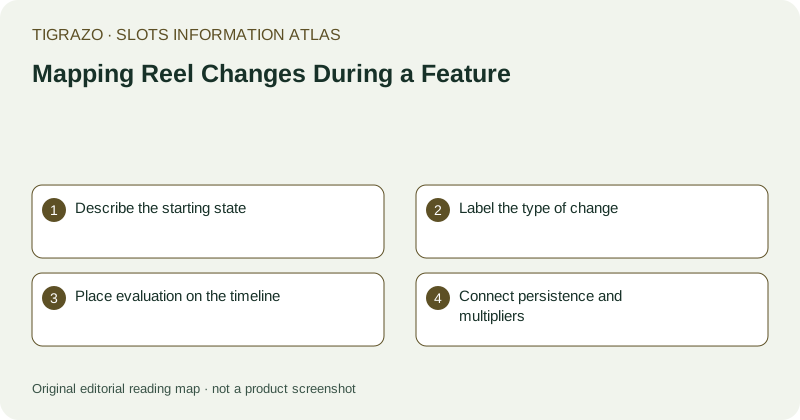
Describe the starting state
Record the base dimensions, active positions and evaluation mechanism before any change occurs. If a feature begins from a different arrangement, give that state its own node. Avoid treating the opening screen as a permanent description of the whole game. A larger frame may contain inactive positions, and an animated symbol can move without changing the underlying evaluated location. The map needs operational positions, not just a visual sketch. Identify the rule that tells you which cells participate at each stage.
Label the type of change
Expansion adds eligible positions only when the rule says so. A transformation changes symbol identity. A shift moves symbols between positions. A refill introduces replacements after specified symbols are removed. These actions can appear together but should remain distinct nodes. For each one, record its trigger, affected area and duration. A reel that appears taller during an animation may not use the extra positions for the current award. A symbol that changes colour may indicate a state change, or merely presentation; the documentation decides which.
Place evaluation on the timeline
Consider a hypothetical sequence: an initial layout is evaluated, winning symbols are removed, new positions become active, replacement symbols arrive and another evaluation occurs. The expanded area belongs to the second evaluation, not retroactively to the first. A different game could expand before its first evaluation, producing a different interpretation. Write before and after explicitly beside every rule. This is especially important when several animations overlap, because their visual order may be less clear than the logical sequence described by the information panel.
Connect persistence and multipliers
Some changes remain for one evaluation; others persist through an entire feature. Track reset conditions separately from activation. If a multiplier increases after a removal cycle, determine whether it applies to the award just completed or the next one. If a symbol is sticky, identify whether it stays at a fixed position, follows a moving reel or remains only while a condition holds. Do not fill those details from the everyday meaning of sticky or expanding. Such labels summarise mechanics but do not replace their full rules.
End with a state checklist
For each stage, list dimensions, active positions, symbol state, multiplier, evaluation rule and reset condition. A short table on paper can reveal a missing connection quickly. If you cannot tell which state an award used, leave the amount unresolved rather than combining elements from different moments. Reel changes do not themselves establish a higher expected return or a predictable award. The map's achievement is narrower and useful: it lets a reader reconstruct a documented sequence without counting inactive positions, duplicating awards or applying a future multiplier too early.