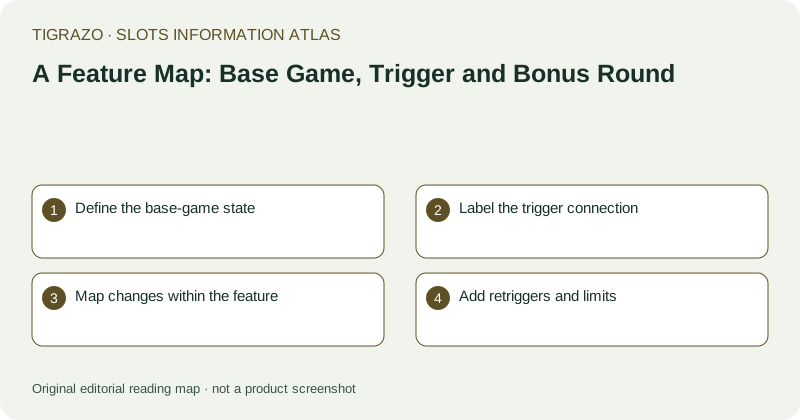
Define the base-game state
The base-game node contains the ordinary layout, stake and evaluation rules. Place special symbols here only with their documented roles in this state. A symbol can look identical inside and outside a feature while behaving differently, so avoid a single unqualified definition that covers both. The base state also supplies the starting point for a trigger check. A normal award and a trigger may be evaluated on the same spin, but whether both pay and how they combine must be established by the rules.
Label the trigger connection
A useful trigger label includes the event, eligible positions, required count and applicable mode. For a hypothetical example, three marked symbols on specified reels might award six bonus spins. That tells you how entry occurs, not how those spins will pay. Some triggers open a selection stage or choose among variants. Add such intermediate nodes instead of jumping directly from symbol appearance to a generic bonus. This preserves the difference between satisfying a trigger, choosing a mode and beginning the awarded sequence.
Map changes within the feature
Inside the bonus, identify initial rounds, multiplier state, reel changes and persistent symbols. Draw each change beside the event that causes it. If a multiplier increases after a winning round, its new value belongs to the following evaluation unless the rules specify otherwise. If a wild remains for three rounds, the persistence boundary must be counted. These details make a feature map more than a list. They show how one state becomes another and prevent the same visual element from being interpreted inconsistently across the sequence.
Add retriggers and limits
A retrigger is a connection that adds actions or changes the state during the feature. Its condition can differ from the initial trigger. Label the extra rounds or other effect explicitly and note any limit. Also connect award caps or maximum-round conditions to the appropriate ending node. A feature may stop when a documented cap is reached, even if an apparent counter would otherwise continue. Do not infer that the loop must repeat until a large award arrives. A possible retrigger is not a promise of continued play or payment.
End with settlement and reset
The final node combines awards according to the game's settlement rules and returns to the appropriate state. Record which multipliers, symbols and counters reset. If the feature summary includes earlier awards, do not add them again without checking. The map should distinguish a feature total from its individual components and from net balance change after the initiating stake. Its purpose is chronological clarity, not an estimate of feature value. Without probability information, a detailed feature description still cannot reveal a typical payout or predict the result of the next entry.