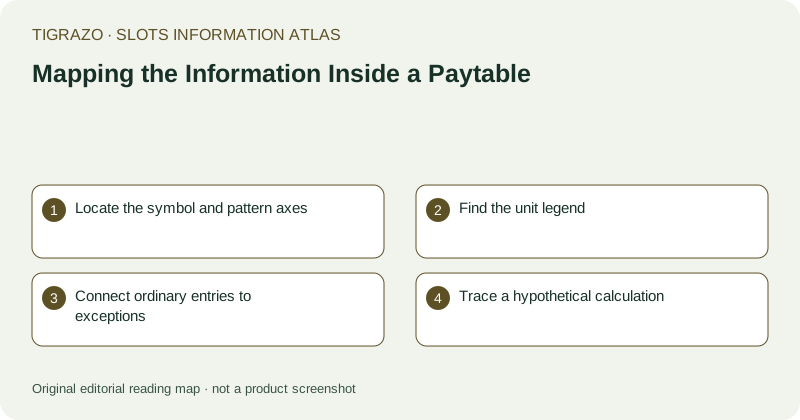
Locate the symbol and pattern axes
The first route crosses symbol identity with qualifying count or pattern. A row may describe one symbol, a symbol family or a particular feature result. Columns might represent three, four and five matches, or bands of cluster sizes. Read the headings before selecting an entry. A number beside a symbol does not automatically apply to every appearance of that symbol. The qualifying pattern is part of the address, just as important as the artwork used to identify the row.
Find the unit legend
The next connection leads to payout units. Entries may be expressed in coins, line-stake multiples, total-stake multiples or currency amounts updated for a selected configuration. Copying a number without its unit breaks the map. If the display already shows converted currency, multiplying it by the stake again would be wrong. If the table uses line stake, substituting total stake can overstate the result substantially. Keep the unit legend close to your notes so a correct numerical entry is not applied through an incorrect formula.
Connect ordinary entries to exceptions
Substitution rules, direction rules and minimum matches may appear outside the main grid. Link them to the entries they affect. A wild may not substitute for a particular special symbol. Only the highest qualifying award on a line may count. A scatter may be evaluated by a separate rule. None of these conditions should be inferred from empty cells or visual spacing alone. A table can be perfectly legible and still require surrounding text to determine which displayed values can be combined.
Trace a hypothetical calculation
Suppose a hypothetical table gives four bells a payout of fifteen times line stake. With a line stake of 0.04 currency units, the award is 0.60. That calculation has four linked nodes: qualifying four-bell pattern, selected table entry, line-stake unit and current line-stake amount. If the pattern is not eligible, the arithmetic is irrelevant. If the unit is unknown, the currency result is unsupported. Mapping those links makes it possible to identify whether an error came from rule selection or multiplication.
Keep separate information on separate branches
An RTP statement, a maximum-award display and a feature-purchase price may sit near the paytable, but they answer different questions. RTP describes long-run expected return over wager volume. A maximum describes a limit. A purchase price describes a cost. None replaces the payout entry for a qualifying pattern. Finish the map by recording configuration and mode qualifiers. Where information conflicts or a unit remains missing, preserve that uncertainty rather than filling it from a similar game. The goal is a traceable interpretation, not merely a plausible-looking total.