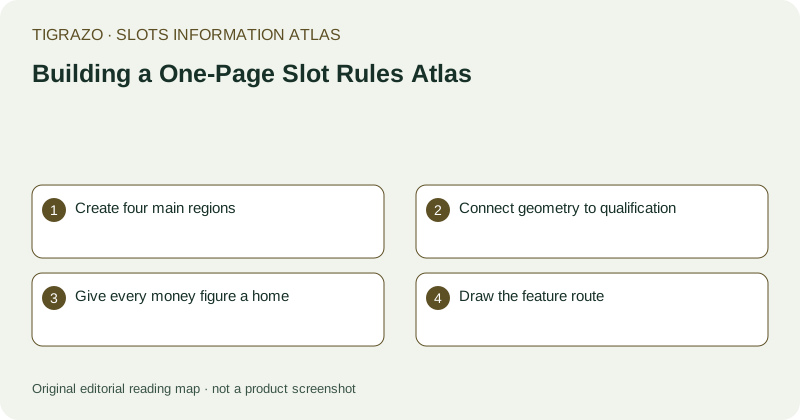
Create four main regions
Divide the page into layout and evaluation, symbols and exceptions, costs and awards, and features and settlement. These regions answer different questions, so avoid one long undifferentiated list. Put the game configuration and mode at the top where they qualify the entire page. Leave a small area for unresolved conditions. The atlas should remain useful even when that area is not empty. Its purpose is to preserve what is known and direct further reading, not to make the available information appear more complete than it is.
Connect geometry to qualification
In the first region, state reel or grid dimensions, active positions and the award mechanism. Add direction and minimum qualification beside that mechanism. In the symbol region, list ordinary roles, wild substitutions, scatter functions and special actions. Link exceptions directly to the rule they modify. A short note saying wild excludes special trigger symbols is more useful beside substitution than hidden at the page's bottom, if that is the documented rule. Avoid deriving any of these conditions from artwork or familiarity with another game.
Give every money figure a home
Record total stake, relevant components, payout basis, optional purchase prices and caps in separate labelled fields. Include one clearly hypothetical conversion only if it helps explain units. For example, a hypothetical eight-times-total-stake award at 0.25 gives a payout of 2.00. That is distinct from net change, which would be plus 1.75 if the stake is deducted separately. Do not crowd the region with maximum figures while leaving ordinary cost units unclear. The map should make commitments easier to understand, not emphasise large possible awards.
Draw the feature route
Use a short sequence: trigger, entry state, changes, retriggers, ending condition and settlement. Add persistence and reset notes where they affect the sequence. If a cap can stop a feature, connect it to the ending condition. If awards aggregate only in a particular way, place that rule beside the settlement node. Recorded round history belongs at the end of the route where available. For an interrupted display, the atlas should point toward checking the recorded result and support details, not repeated paid actions or redepositing to test the interface.
Audit clarity before compressing further
Read the page as if you had not written it. Can you identify what is committed, what qualifies, how an amount is calculated and what changes during a feature? Add configuration-specific RTP with its long-run meaning only if established, keeping hit frequency and volatility separate. Remove decorative detail before removing a meaningful condition. If the page cannot hold an exception clearly, point to the relevant full-rule topic in plain text. A successful atlas is concise, traceable and honest about uncertainty; it does not predict results or imply that understanding the map creates a winning method.