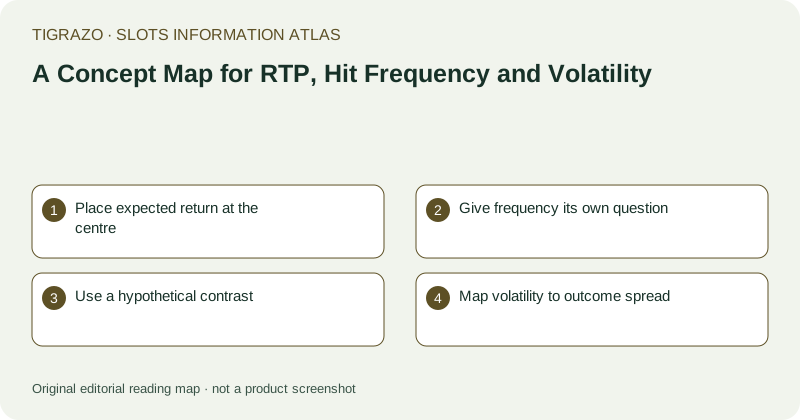
Place expected return at the centre
RTP expresses long-run expected return relative to wager volume under the applicable game model and configuration. In a hypothetical example, 96 percent RTP corresponds to expected return of 96.00 for every 100.00 of wager volume. Actual results over a particular session can differ substantially. This node connects probabilities and award sizes to a mathematical mean. It does not connect directly to a guaranteed session balance, a fixed refund or a point at which previous losses must be recovered. Those would be different and unsupported claims.
Give frequency its own question
Hit frequency asks how often a defined event occurs, commonly any qualifying payout. The event definition matters because a payout smaller than the stake may count. In a hypothetical model with a 1.00 stake, a 0.20 payout is a positive award but a net change of minus 0.80. Record frequency beside its event definition, not beside an assumed meaning of success. A high percentage of positive payouts cannot establish RTP without the sizes and probabilities of the rest of the distribution.
Use a hypothetical contrast
Imagine one simplified hypothetical model paying 1.00 half the time and zero otherwise for a 1.00 stake. Its hit frequency is 50 percent and its RTP is 50 percent. A second model pays 5.00 one time in ten and zero otherwise. Its hit frequency is 10 percent and its RTP is also 50 percent. These deliberately simplified examples are not actual game claims. They show that identical expected returns can coexist with different award frequencies and very different experiences across short sequences.
Map volatility to outcome spread
Volatility concerns the spread and concentration of possible outcomes. The second hypothetical model concentrates return in rarer, larger awards, illustrating a different spread from the first. In actual descriptions, labels such as low or high volatility may use different methods and need a documented definition to support precise comparisons. A label does not reveal a guaranteed maximum losing streak or a schedule for large awards. Connect volatility to the distribution, not to statements about a game becoming ready after a quiet period.
Draw boundaries around predictions
The three concepts can inform understanding but cannot specify the next independent spin's result. RTP supplies a mean, hit frequency supplies an event rate and volatility concerns spread; none creates an entitlement to payment after losses. Configuration qualifiers belong on all numerical claims where relevant. If one measure is missing, do not derive it casually from another or from recent outcomes. A complete map is allowed to contain unknowns. Its purpose is to make each question precise and prevent attractive numbers from answering questions they do not actually address.