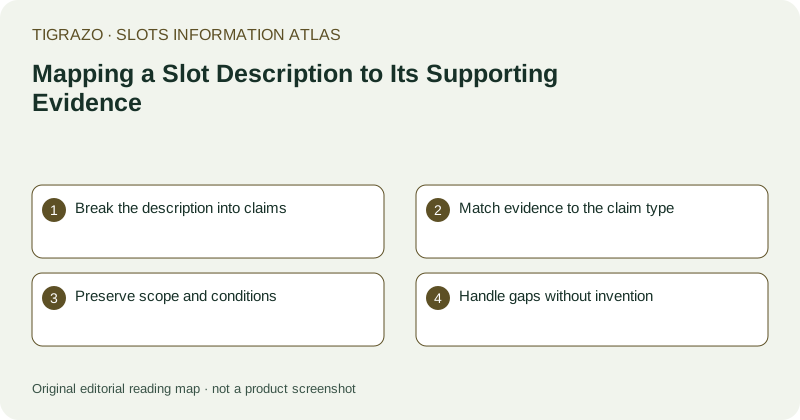
Break the description into claims
Take a sentence such as five reels, expanding wilds and adjustable audio, and separate it into three claims. Each requires different support. Reel count concerns geometry, expanding wilds concern a mechanic and adjustable audio concerns an interface capability. A single promotional paragraph may mention all three without establishing their limits. Give each claim a node before evaluating it. This avoids a halo effect in which one well-supported detail makes the entire description seem verified, including statements that have not actually been checked.
Match evidence to the claim type
Use the relevant rule for qualification, substitution and feature timing. Use the current labelled configuration for selected stake and mode. Use documented controls or safe interface inspection for settings. A screenshot can show a visible state, but it may not establish persistence, eligibility or future behaviour. A worked calculation can establish arithmetic only after its inputs and units are justified. Matching evidence type to claim type is more reliable than treating any attractive image, long document or familiar term as universal support.
Preserve scope and conditions
A rule that applies during a bonus should not become an unqualified statement about every spin. A sound setting observed in one browser should not automatically become a claim about all devices. Add mode, version and inspection conditions wherever they affect meaning. If a number represents an illustrative calculation, label it hypothetical. In a hypothetical example, ten times a 0.20 stake equals 2.00, but that arithmetic does not prove an actual game awards ten times stake or that the outcome is likely. The map must preserve that distinction.
Handle gaps without invention
When a claim lacks support, choose among narrowing it, marking it unresolved or removing it. Do not replace missing evidence with what similar games usually do. If two associated explanations conflict, retain the conflict in your working notes rather than choosing the more convenient version. An accurate description can be shorter than the original promotional text because it contains only what can be established. It can also explain that a specific condition remains unclear without making accusations about intent, quality or the underlying operation.
Audit the final route
For each retained claim, ask what supports it, what that support actually establishes and what limitations remain. Keep mathematical characteristics separate: RTP is not hit frequency, volatility is not a waiting-time promise and a maximum is not a typical award. Avoid firsthand language unless an actual observation justifies the narrow statement being made. The completed evidence map should let another reader retrace the reasoning. Its value lies in traceability and honest boundaries, not in producing a flattering verdict, a larger feature list or a persuasive reason to wager.